
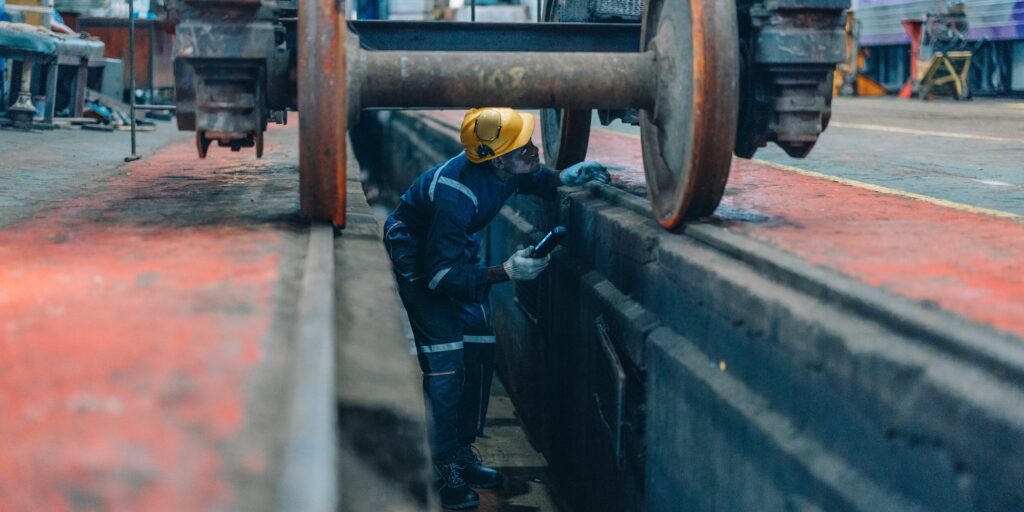
Railway welding is one of the most demanding specialties in the wider industrial welding world. Unlike many general fabrication environments, railway applications combine strict safety expectations, traceability, repeatability, and long service-life requirements.
That is why railway welding certification is not just about proving manual skill with a torch or electrode holder. It usually involves a broader system that can include company certification, qualified welding procedures, welder or operator qualification, inspection competence, and documented quality management. In practice, the exact route depends on where the work is being done and whether the application involves rolling stock, components, or rail infrastructure itself.
What does “railway welding certification” actually mean?
A common misunderstanding is to think there is one universal railway welding certificate valid everywhere. In reality, certification usually sits on several levels.
At the personnel level, welders are often qualified to standards such as ISO 9606, while operators working with mechanized or automatic processes may be qualified under ISO 14732. For inspection, personnel may also need qualifications aligned with ISO 9712 for non-destructive testing.
This distinction matters because railway projects involve more than individual technique. A rail-sector supplier may need approved welding procedures, competent welding coordination, documented inspection routines, and evidence that the organization can consistently reproduce weld quality. That is why company-level approval and personnel-level qualification are often treated as complementary rather than interchangeable.
The main standards you should know
For individual welders, ISO 9606 is highly relevant because it covers qualification testing of welders for metallic materials. Welder qualification evaluates whether a welder can produce welds to an industry standard following a defined welding procedure, which is the foundation for certification.
For railway vehicles and components in Europe, EN 15085 is the standard most frequently associated with railway welding certification. It is the European standard for the design, manufacture, and testing of railway vehicles and equipment, while EN 15085-2 certification demonstrates the qualification of employees, technical equipment, and compliance with welded product requirements.
For mechanized and automatic welding, ISO 14732 becomes important. This standard specifies the requirements for the testing of operators and setters for mechanized and automatic welding of metallic materials. This is increasingly relevant as automation and digitalization become more common in rail manufacturing and maintenance environments.
For inspection and quality control, ISO 9712 is often part of the ecosystem because it defines qualification and certification requirements for NDT personnel. TÜV Rheinland explicitly notes that ISO 9712 personnel qualification is required in railway welding systems such as EN 15085.
In the United States, the framework can look different. AWS identifies AWS D15.1/D15.1M:2025 for railroad cars and locomotives and AWS D15.2/D15.2M:2022 for joining railroad rail and related rail components. AWS states that D15.2 addresses procedure qualification, welder performance qualification, safety procedures, inspection methods, and acceptance criteria.
What the certification process usually includes
Although details vary, most railway welding certification pathways include five core elements.
First, there is process qualification. Companies need to prove that a welding procedure can reliably achieve the required properties and quality level for a given joint, material, and application.
Second, there is welder or operator qualification. Manual welders are typically tested under ISO 9606, while operators of mechanized or automatic equipment are commonly tested under ISO 14732.
Third, there is welding coordination. In railway production, this role is critical because compliance depends not only on welding skill but also on planning, supervision, documentation, and quality assurance.
Fifth, there is organizational quality capability. TÜV notes that ISO 3834 certification is linked to valid welder certification under EN ISO 9606 and operator certification under EN ISO 14732 for automatic processes, showing how quality management and personnel competence are tied together.
How digital training improves railway welding skills
Passing a railway welding qualification is not only about practicing more. It is about practicing correctly, consistently, and with measurable progress. That is why modern training methodology is shifting toward structured, data-informed learning rather than relying only on repeated live welding.
In high-demand sectors such as rail, instructors need to verify angles, travel speed, sequence, stability, and defect tendencies before trainees move into expensive or safety-critical real-world production. This is where digitalization is changing the training conversation.
Why Seabery is a strong fit for railway welding training
Seabery highlights analytics-based evaluationand also emphasizes that Augmented Reality (AR) training can reduce material consumption while enabling safer skill acquisition before moving to real welding conditions.
For organizations preparing welders for rail-sector demands, Seabery’s solution is especially relevant because it aligns with the realities of industrial, standards-driven training.
Seabery Welding Simulator is designed to improve welding processes, intensify practice, and make course management more dynamic and flexible. With this welding solution you can digitalize training programs, support flexible course deployment, and deliver performance tracking through data.
As a summary, a digital and analytics-based AR welding simulator can make the path to certification more efficient. It helps instructors build stronger fundamentals, improve consistency, and prepare candidates for real assessments with a more controlled methodology.
Alstom Spain used this solution in 2021 for welder selection and training according to company standards in a railway manufacturing context. That makes the platform particularly well suited to certification-oriented environments where methodology, repeatability, and measurable progression are essential.
Building certification with better training
Railway welding certification is best understood as a system, not a single document. For training providers and industrial companies, the challenge is not only meeting the standard but building a reliable learning pathway toward it. That is exactly why automation, digitalization, and augmented reality are becoming so valuable in modern welding education.
The strongest railway welding programs combine standards, qualified personnel, and measurable practice. When those elements come together, certification stops being just an administrative requirement and becomes a genuine driver of quality, safety, and long-term performance.