
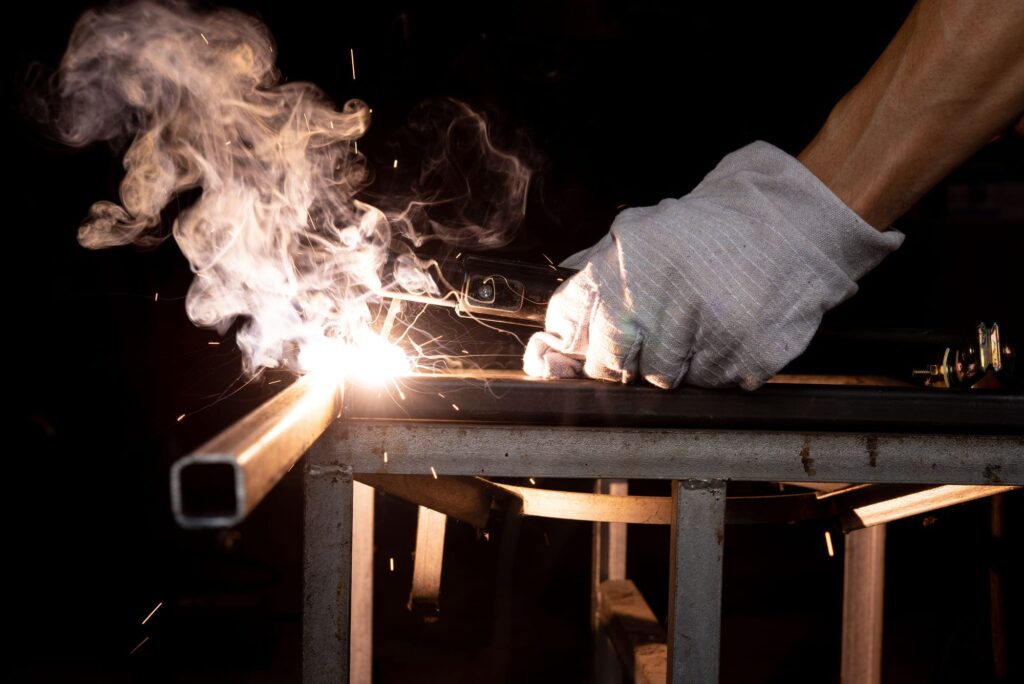
Welded joints help create the structures, machines, and systems that support everyday life. For beginners, welding may seem like a purely manual activity, but it is actually a technical discipline that combines safety, material knowledge, precision, methodology, and continuous practice.
Learning the basics correctly from the beginning is critical. A good foundation helps future welders develop safer habits, improve weld quality, reduce errors, and adapt more easily to new technologies.
What is welding?
Welding is a fabrication process used to join materials, usually metals, by applying heat, pressure, or both. In most common industrial applications, heat is used to melt the base materials and, in many cases, a filler material is added to create a strong joint.
Arc welding processes use an electric arc to generate the heat needed to melt the metal and form the weld. Common arc welding processes include MIG/GMAW, TIG/GTAW, Stick/SMAW, and Flux-Cored/FCAW welding.
For beginners, the first step is to understand that welding is not only about “joining metal.” A good weld must meet specific requirements related to penetration, fusion, bead appearance, strength, safety, and the application in which the welded part will be used.
Understanding the main welding processes
One of the most important welding basics is knowing the difference between common processes. A beginner does not need to master every process immediately, but understanding the basic differences helps learners choose the right training path.
MIG Welding | Also known as Gas Metal Arc Welding or GMAW. It uses a continuously fed wire electrode and shielding gas. It is widely used in industrial environments because it is relatively fast, productive, and easier to learn than some other processes. MIG welding is often a better place to start learning the basics than TIG because beginners can usually produce acceptable welds more easily. |
TIG Welding | Also known as Gas Tungsten Arc Welding/GTAW. It uses a non-consumable tungsten electrode and an inert shielding gas, usually argon. AWS explains that GTAW creates an arc between the tungsten electrode and the workpiece, while shielding gas protects the weld zone from oxygen and nitrogen. It is valued for precision but requires strong coordination and control. |
Stick Welding | Also known as Shielded Metal Arc Welding/SMAW. It uses a consumable electrode covered with flux. It is versatile and commonly used in construction, maintenance, and outdoor work, but it requires practice to control the arc, slag, and electrode angle. |
Flux-Cored Arc Welding | Also known as FCAW. It is similar to MIG but uses a tubular wire filled with flux. It is common in heavy industrial applications because it can offer high deposition rates and good productivity. |
Key welding variables every beginner must control
Before beginners can produce consistent and high-quality welds, they need to understand that welding is not controlled by a single movement or setting. Every weld is the result of several variables working together. When one of these elements is incorrect, the final weld can be affected in terms of appearance, penetration, strength, and overall quality.
Safety always comes first
Before touching any welding equipment, beginners must understand safety. Welding involves heat, sparks, electrical current, ultraviolet radiation, fumes, and molten metal. Welding hazards are identified such as burns, eye damage, electrical shock, cuts, crushed fingers or toes, exposure to metal fumes, and exposure to UV radiation. Many of these risks can be controlled through proper work practices and personal protective equipment.
Basic welding safety includes wearing a welding helmet with the correct shade lens, flame-resistant clothing, leather gloves, safety boots, and eye protection. OSHA also requires helmets or hand shields for arc welding and proper eye protection for gas welding or cutting operations.

Ventilation is another key point. Welding fumes can be harmful depending on the material, coating, filler metal, and process used. Beginners should learn to work in well-ventilated areas and follow the safety procedures established by instructors, employers, and local regulations.
Core welding controls
Good welding depends on controlling several variables at the same time. These include travel speed, work angle, travel angle, arc length, voltage, amperage, wire feed speed, electrode position, and distance from the workpiece.
Travel speed affects bead shape and penetration. Moving too fast can produce a narrow weld with poor fusion, while moving too slowly may create excessive heat input and distortion. Torch or electrode angle also matters because it influences how the heat and filler material are directed into the joint.
Beginners should also learn the importance of consistent body positioning. Welding is a physical skill, and stability affects accuracy. Good posture, steady hands, and clear visibility of the weld pool are essential for repeatable results.
Materials, joints, and positions
Another welding basic is understanding the material being welded. Different metals react differently to heat. Mild steel, stainless steel, and aluminum require different settings, techniques, filler metals, and preparation methods. Beginners should start by learning how to identify the base material and understand how heat affects it.
Joint types are also important. The most common include butt joints, lap joints, T-joints, corner joints, and edge joints. Each joint requires a specific preparation and welding technique.
Welding positions add another layer of difficulty. Flat and horizontal positions are usually easier for beginners, while vertical and overhead welding require more advanced control. Structured welding training often progresses gradually from basic positions to more complex ones.
Preparation and cleanliness
Many beginner mistakes happen before the arc is even started. Proper preparation is essential for weld quality. Surfaces should be clean and free from oil, rust, paint, moisture, or other contaminants. Poor preparation can cause porosity, lack of fusion, cracking, or weak welds.
Fit-up also matters. If parts are misaligned or the gap is inconsistent, the welder will have more difficulty maintaining a uniform bead. Tack welds, clamps, and correct measurement help keep the workpiece stable during welding.
Reading welds and learning from defects
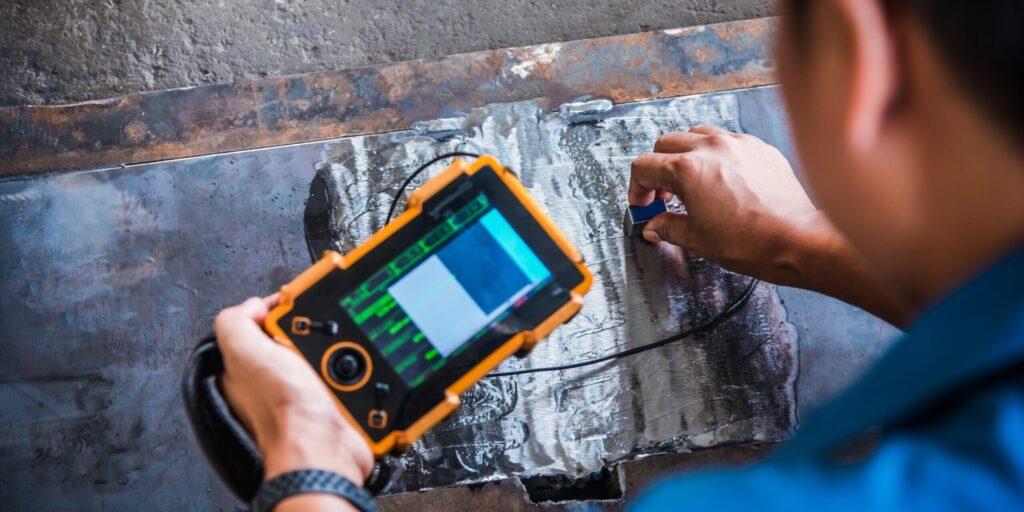
Beginners must learn to evaluate their welds. Common defects include porosity, undercut, lack of fusion, excessive spatter, overlap, cracks, and inconsistent bead shape. Each defect has a cause, and each cause can be corrected through better technique, settings, preparation, or methodology.
The American Welding Society includes welding terminology, metallurgy, welding discontinuities, safety, and core welding processes in its welding fundamentals training content, showing that good welding education goes beyond manual practice alone.
Why methodology matters in welding training
Welding is learned through repetition, but repetition without feedback can reinforce bad habits. A structured methodology helps beginners move from theory to guided practice and then to real workshop application.
This type of structured approach is especially important in an industrial context, where welders must meet quality standards, work safely, and adapt to increasingly automated production environments. As automation grows, welders are not disappearing; instead, their role is evolving. They need to understand processes, inspect quality, interpret parameters, and work with digital tools.
How Seabery supports welding beginners and industrial skills development
Seabery’s Augmented Training methodology is designed to improve welding learning processes, promote intensive practice, and give teachers flexible tools to manage students with different levels, learning rhythms, and locations. The e-learning platform also works as an LMS that allows instructors to create content, manage courses, control student evolution, and interact with learners in real time.
This makes Seabery Welding Simulator relevant not only for educational institutions, but also for industrial companies that need to train, reskill, or evaluate welding personnel. In sectors such as automotive, aviation, railway, shipbuilding, oil and gas, and heavy manufacturing, welding quality is directly connected to productivity, safety, and compliance. By combining Augmented Reality, data, automation, and digitalization, Seabery helps bridge the gap between traditional welding instruction and modern industrial training needs.
Seabery Welding Simulator is an Augmented Reality welding solution designed to support the acquisition of welding skills through a safer, more measurable, and more efficient training methodology. Soldamatic provides a realistic welding simulator training experience powered by HyperReal SIM, combining physical welding elements with Augmented Reality to help learners practise before moving into the real workshop.
For beginners, this is especially valuable because it allows intensive practice without the same level of risk, material consumption, or pressure associated with traditional first-time welding. Learners can focus on essential parameters such as travel speed, work angle, arc length, and positioning while receiving objective feedback on their performance.
Building strong welding foundations
Welding beginners must start with the essentials: safety, process knowledge, material preparation, correct technique, structured practice, and continuous feedback. These basics create the foundation for future specialization and professional growth.
As the industrial world becomes more digital and automated, welding training must also evolve. Augmented Reality technology help learners build confidence, improve performance, and develop job-ready skills through a modern and measurable methodology.