
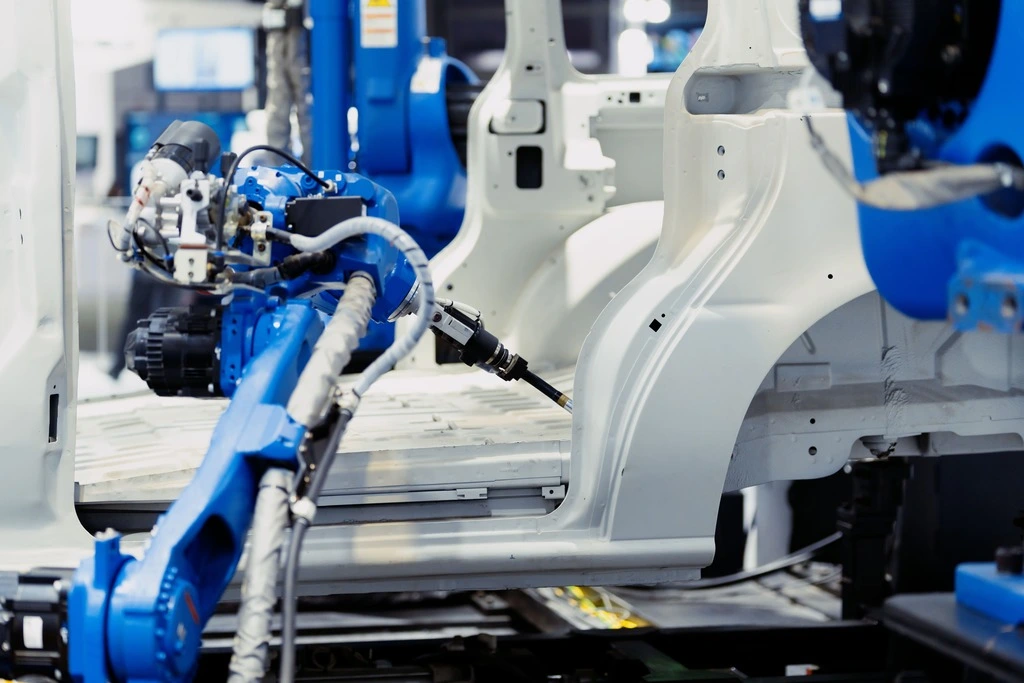
Automotive manufacturing has always been one of the most automated industrial sectors. However, welding automation is now evolving beyond traditional robots performing repetitive spot welds. Manufacturers are introducing intelligent sensors, connected production systems, collaborative robots, digital twins and advanced training technologies to improve flexibility, quality and productivity.
This transformation is particularly important as automotive companies adapt their production lines to electric vehicles, new lightweight materials and increasingly customized vehicle platforms. Understanding the latest automotive welding automation trends can help manufacturers prepare their facilities and workforce for a more connected and flexible production environment.
Why automotive welding automation continues to grow?
Automotive plants depend on thousands of welds to assemble vehicle bodies, chassis, subframes, exhaust systems, battery structures and other critical components. Even a small variation in welding quality can affect structural integrity, production costs and delivery schedules.
Industrial robots provide the speed, repeatability and accuracy required for high-volume automotive manufacturing. According to preliminary data published by the International Federation of Robotics, the automotive industry remained the largest adopter of industrial robots in the United States, installing approximately 13,500 units in 2025.
Automation is therefore no longer limited to the largest vehicle manufacturers. Tier 1 and Tier 2 suppliers are also adopting modular welding cells, collaborative robots and more accessible programming systems to automate smaller production batches.
1. Smarter robotic welding cells
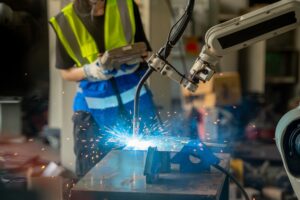
One of the most important trends is the transition from isolated welding robots to intelligent, connected welding cells. Modern robotic cells can integrate:
- Welding power sources.
- Robot controllers.
- Seam-tracking sensors.
- Vision systems.
- Positioners and fixtures.
- Quality monitoring software.
- Manufacturing execution systems.
- Predictive maintenance platforms.
This connectivity allows manufacturers to collect production information from every welding cycle. Instead of inspecting only the finished component, companies can monitor welding parameters during production and detect deviations before they result in widespread defects. Connected cells also make it easier to compare performance between production lines, shifts or manufacturing plants.
2. Artificial Intelligence and adaptive welding
Traditional robotic welding follows predefined trajectories and parameters. However, real components may present variations caused by tolerances, positioning errors, thermal distortion or differences between material batches.
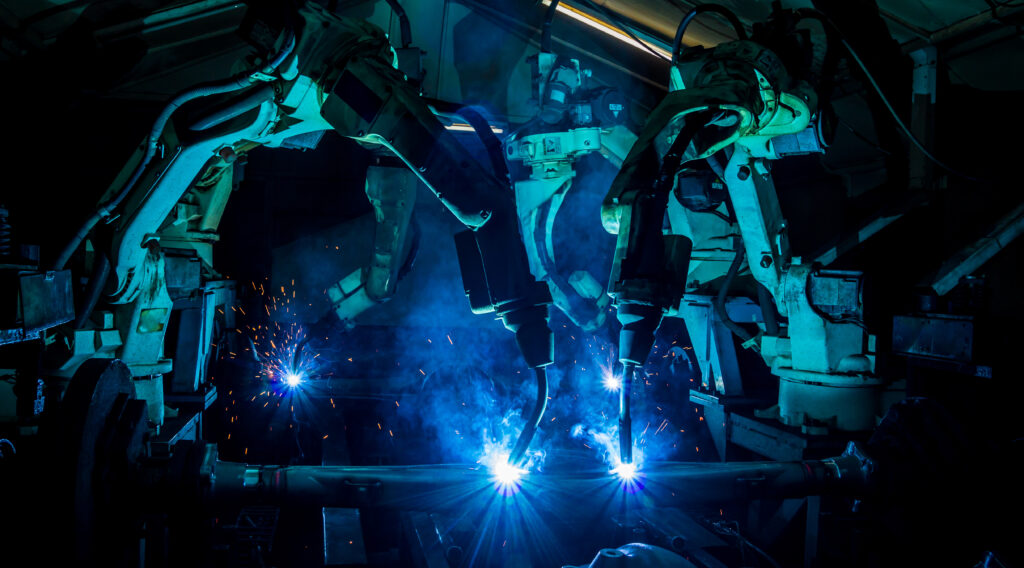
Adaptive welding systems use sensors and software to modify the process while welding. Depending on the application, the system may adjust:
- Torch position.
- Travel speed.
- Voltage and current.
- Wire feed speed.
- Work angle.
- Distance from the joint.
- Robot trajectory.
Artificial intelligence and machine-learning models can also analyze historical welding data to identify patterns related to defects, equipment wear or process instability.
The goal is not simply to automate the movement of the torch: the goal is to create a welding process that can respond to changing production conditions while maintaining consistent quality.
3. Advanced vision and seam-tracking systems
Vision technology is becoming an essential component of automotive welding automation.
Cameras, laser scanners and integrated sensors help robots locate components, recognize joints and correct their trajectories. These systems are especially useful when parts are not positioned exactly as expected or when heat distortion changes the geometry of a joint. Integrated vision also supports flexible production lines where different vehicle models or component variants are manufactured within the same facility.
FANUC highlights vision systems, predictive-maintenance tools and multi-robot integration as key technologies for improving the accuracy, reliability and uptime of automated spot-welding operations. Its automotive solutions also emphasize the importance of repeatability for vehicle frames, body components and electric-vehicle battery structures.
4. Collaborative robots and easier programming
Collaborative robots, or cobots, are making welding automation accessible to manufacturers that may not have extensive robotics expertise.
Unlike conventional automotive body shops containing large numbers of robots behind safety fencing, collaborative welding systems are often designed for smaller batches and more flexible operations. They can help automate repetitive welds while experienced welders focus on setup, inspection, complex joints and process optimization.
Another important development is no-code or low-code programming. Operators can increasingly teach a welding trajectory by guiding the robot, selecting points through a graphical interface or importing information from a digital model.
For example, ABB’s collaborative arc-welding cell uses auto-generated programming and an easy-teach device designed to reduce robot programming time. The company states that this configuration can save up to 70% of programming time for suitable applications.
5. Digital twins and offline programming
Digital twins allow manufacturers to create virtual representations of robotic welding cells, components and production processes. Digital simulation also supports faster product launches because welding routines can be prepared before the final production cell is fully available. Engineers can use these environments to:
- Design and validate robotic cells.
- Test torch accessibility.
- Identify potential collisions.
- Optimize cycle times.
- Simulate fixtures and positioners.
- rogram robot trajectories offline.
- Evaluate alternative production layouts.
Offline programming reduces the amount of time that physical equipment must be stopped for testing or reprogramming. This is particularly valuable in automotive manufacturing, where every minute of production downtime can be expensive.
6. Predictive maintenance and connected equipment
Automotive manufacturers are increasingly using production data to predict when welding equipment will require maintenance. This approach is gradually replacing purely reactive maintenance.
Robot movements, torch conditions, wire-feed behavior, cycle times and equipment alarms can be continuously monitored. When the system detects an unusual pattern, maintenance teams can intervene before a breakdown stops the line. Predictive maintenance can help automotive manufacturers:
- Reduce unexpected downtime.
- Extend equipment life.
- Plan maintenance during scheduled stoppages.
- Identify deteriorating welding performance.
- Improve spare-parts management.
7. Automation for electric vehicle manufacturing
The expansion of electric-vehicle production is creating new welding challenges. Automation systems must be flexible enough to manage these different processes while protecting sensitive components and maintaining strict quality requirements.
EV manufacturing introduces components such as battery trays, battery modules, lightweight structural assemblies and mixed-material vehicle bodies. These parts may require high levels of precision, thermal control and process monitoring. Automotive manufacturers are therefore combining several joining technologies, including:
- Resistance spot welding.
- Gas metal arc welding.
- Laser welding.
- Laser brazing.
- Friction-based processes.
- Robotic adhesive application.
- Automated riveting and mechanical fastening.
Automotive welding automation trends at a glance
|
Trend |
Main application |
Key benefit |
|
Adaptive welding |
Real-time parameter and trajectory correction |
More consistent weld quality |
|
Vision and seam tracking |
Joint detection and component positioning |
Greater accuracy and flexibility |
|
Collaborative robots |
High-mix and lower-volume production |
More accessible automation |
|
Digital twins |
Virtual cell design and offline programming |
Less commissioning time |
|
Predictive maintenance |
Connected robots and welding equipment |
Reduced unplanned downtime |
|
EV-focused automation |
Battery and lightweight structures |
Precise control of new applications |
|
Digital workforce training |
Robot operation and welding-process preparation |
Faster and safer upskilling |
The workforce behind automotive welding automation
Advanced automation does not eliminate the need for skilled professionals. Instead, it changes the skills required in automotive welding environments.
Companies need employees who understand both welding and automation. Operators must be able to recognize whether a problem is related to robot programming, component positioning, welding parameters, consumables or joint preparation. Robotic welding training should therefore include:
- Welding-process fundamentals.
- Robot programming.
- Tool and user frames.
- Welding trajectories.
- Process scheduling.
- Parameter selection.
- Safety procedures.
- Quality analysis.
Training directly on production robots can be costly and disruptive. It can occupy valuable equipment, consume materials and expose inexperienced learners to industrial risks.
Preparing automotive teams with Seabery
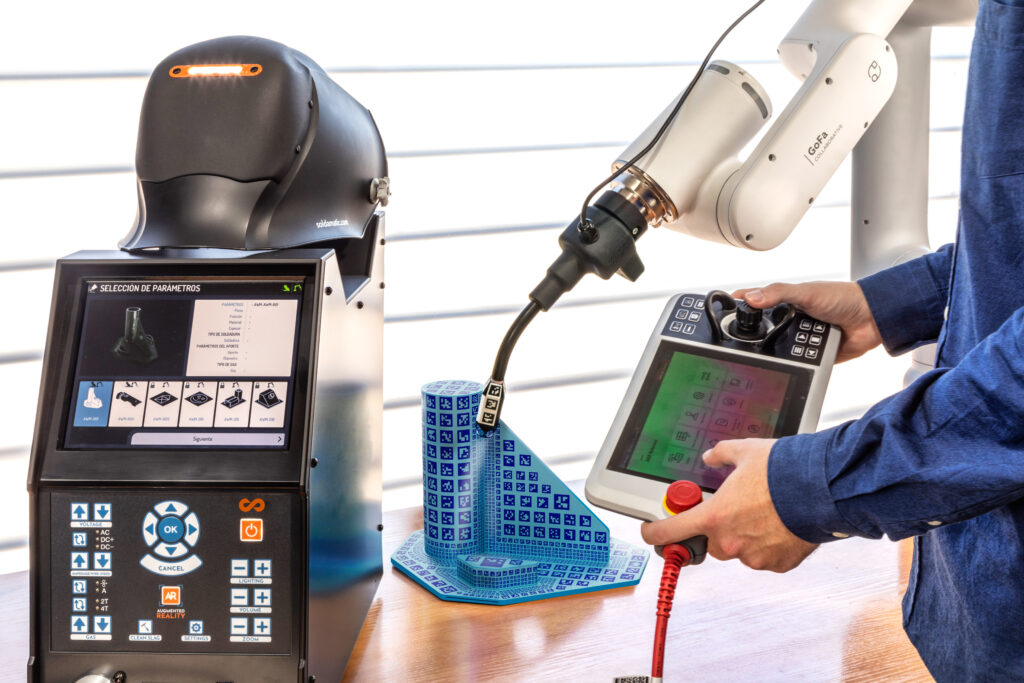
Seabery Robotics Welding Simulator provides an Augmented Reality-based environment for robotic welding training. It combines simulation with real components and can be integrated with different robot brands.
Operators can learn robot programming, tool frames, user frames, process scheduling and welding routines before working with live production equipment. They can also test program changes, trajectory corrections and welding parameters without interrupting an automotive production cell.
For manual welding operations within automotive manufacturing, Seabery Welding PRO enables companies to digitalize customer-specific parts through its Digital Replica approach. Welders can practice on virtual representations of real production components while following company-specific WPSs and analyzing measurable performance indicators.
The system combines real welding equipment with Augmented Reality simulation, helping manufacturers develop welding skills without consuming production materials or exposing trainees to live-arc risks. Seabery states that its customer applications have achieved proficiency up to 33% faster and reductions of up to 66% in raw materials, energy and consumables, although results depend on the particular implementation.
The future of automotive welding automation
The future of automotive welding will combine robotics, intelligent process control, digital simulation and highly skilled workers.
Robots will continue to perform repetitive and high-volume operations, but the most competitive automotive manufacturers will be those capable of connecting automation with quality data, flexible programming and effective workforce development.
By using tools such as robotic simulation, Augmented Reality and digital replicas, automotive companies can prepare operators before they enter the production environment. This supports faster technology adoption, safer training, reduced downtime and more consistent welding quality across increasingly complex vehicle-production processes